AI Interview Practice Checklist: Timed Mocks, STAR & Feedback

AI for Job Interview Practice: A Step-by-Step Checklist for Confident Interviews
Interview prep works best when it’s repeatable: the same role-focused questions, the same structure for strong answers, and the same feedback loop until your delivery sounds natural. AI can make that repetition easier by helping you generate realistic questions, pressure-test responses, and spot where answers get vague, too long, or off-target. Use the checklist below to turn AI practice into a simple routine—from setting a target role and building a tailored question set to running timed mock interviews and refining stories with measurable results.
Set the foundation: role target, constraints, and success criteria
Start by narrowing the practice scope. One role and one level (for example, “Customer Success Manager, mid-level”) keeps your answers specific and reduces “generic interview voice.” Then collect the raw inputs AI needs: the job description, company values, a list of recent projects, performance metrics, and 3–5 signature stories you can reuse across questions.
- Choose one target role and one target level to avoid rehearsing vague, one-size-fits-all answers.
- Gather inputs: job description, company values page, recent projects, metrics, and 3–5 signature stories.
- Define “good” for practice: 60–120 second answers, clear STAR/CAR structure, and role-relevant language that doesn’t sound memorized.
- Pick a format to simulate: recruiter screen, hiring manager deep-dive, panel, case/role-play, or behavioral-only.
- Create a private workspace: one doc for refined answers, a feedback log, and a folder for role-specific resumes.
Quick setup checklist (copy/paste)
| Item | What to prepare | Done |
|---|---|---|
| Target role + level | One specific title and seniority | ⬜ |
| Job description | Full posting text + must-have skills | ⬜ |
| Company signals | Values, product, recent news, competitors | ⬜ |
| Top stories | 3–5 STAR stories with metrics | ⬜ |
| Constraints | Salary range, location, visa, start date | ⬜ |
Build a realistic question bank with difficulty levels
A strong question bank is more than a list—it’s a rotating set that recreates the way interviews actually feel: warm-up questions, role-specific questions, and “stretch” scenarios where details are incomplete or priorities conflict.
- Generate three tiers: warm-up (easy), core (role-specific), and stretch (tradeoffs, ambiguity, edge cases).
- Cover the mix: behavioral, technical/domain, situational, leadership/ownership, collaboration/conflict, and “why this company/role.”
- Add follow-up chains: one main question plus 2–4 probes (scope, constraints, metrics, alternatives, lessons learned).
- Map each question to a competency the role needs (prioritization, stakeholder management, data literacy, etc.).
- Keep 20–30 active questions and refresh weekly so practice stays challenging.
For extra realism, take guidance from structured interview best practices and common employer formats, like those summarized by SHRM and the U.S. Department of Labor’s CareerOneStop.
Turn experience into crisp answers using STAR (without sounding robotic)
AI is most helpful when your raw story is clear. Draft each signature story as a STAR outline, then practice variations so you can answer naturally without reciting.
- Draft one STAR outline per story: Situation, Task, Action, Result.
- For leadership roles, add a “Decision” line: the tradeoff you chose and why.
- Rewrite results into measurable outcomes: dollars, time saved, conversion, retention, quality, risk reduced, or speed improved.
- Trim hard: remove backstory that doesn’t change the decision; keep actions concrete; end with impact and reflection.
- Create a one-sentence version (for screens) and a full 90-second version (for deep dives).
STAR answer quality checks
| Check | What it prevents | Fast fix |
|---|---|---|
| Clear task/goal | Rambling context | State the objective in one line |
| Specific actions | Vague teamwork claims | Use verbs + tools + steps |
| Metrics in results | Unconvincing impact | Add baseline → change → outcome |
| Reflection | No learning signal | End with what you’d repeat/adjust |
Run AI mock interviews like real rounds (timed, recorded, and escalating)
Confidence comes from controlled pressure. Treat practice sessions like real rounds: short thinking time, a firm answer limit, and follow-ups that force you to clarify.
When you’re refining “Tell me about yourself,” align your structure with practical guidance like Harvard Business Review: clear narrative, role fit, and a confident close that sets up the next question.
Use feedback loops that actually change performance
Handle common tough moments: gaps, layoffs, low experience, and failures
Day-before and day-of checklist for calmer delivery
Pick the right AI practice setup: privacy, realism, and fairness
Recommended checklists and downloads
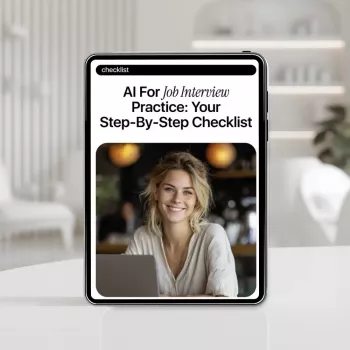
- AI for Job Interview Practice: Your Step-by-Step Checklist | Smart ai for job interview practice Guide for Confident Interviews
- AI Tools Worth Learning: Your Must-Have Checklist | New AI Tools Worth Learning for Creators, Entrepreneurs & Busy Professionals
- Brand Voice AI Mastery Checklist – AI Prompts for Brand Voice Style Guide for Consistent, Engaging, and Professional Content
FAQ
How often should AI interview practice sessions be done to see improvement?
Plan for short daily sessions (15–30 minutes) plus 1–2 full timed mock interviews each week. Pick one improvement target per session (like “shorter answers” or “more metrics”) and track recurring feedback themes.
How can interview answers sound natural when practicing with AI?
Use bullet outlines instead of memorized scripts, lead with your main point first, and practice a few variations of the same story. Recording your delivery helps you replace robotic phrasing and filler words with cleaner pauses.
Is it safe to use AI for interview prep with confidential work examples?
It can be, as long as sensitive details are removed: redact names, proprietary metrics, and internal documents, and use generalized descriptions. Keep a private offline document for the exact specifics you’ll share in the real interview.









Leave a comment